EV Charger Installation for Societies & Dealership Setup
Step into any newly built apartment complex in Delhi, Gurugram, Noida, or Faridabad on a weekday morning, and you'll spot something that simply didn't exist five years ago: a quiet row of cars and two-wheelers drawing po
Step into any newly built apartment complex in Delhi, Gurugram, Noida, or Faridabad on a weekday morning, and you'll spot something that simply didn't exist five years ago: a quiet row of cars and two-wheelers drawing power from wall-mounted units tucked beside the basement parking. Conversations at RWA meetings have shifted too. The questions are no longer "Should we get a charger?" But "Which one, how many, and who do we trust to install it?" That single shift in tone tells you everything about where the Indian mobility market is heading.
Whether you're a society secretary trying to future-proof your community or an entrepreneur eyeing a serious business opportunity, understanding the full picture of EV charger installation has become non-negotiable. This guide walks through what works, what doesn't, and where the real money and impact lie.
1. Why Residential Societies Can't Sit on the Fence Anymore
A few years ago, installing chargers felt like a "nice-to-have" upgrade. That window has closed. Residents are buying EVs faster than RWAs can plan for them, and societies without charging infrastructure are quietly losing value in the real estate market. Buyers and tenants now ask about charging availability the same way they ask about water supply or backup power.
Beyond resident demand, there's a regulatory push. Multiple states have made EV-ready provisions mandatory in new buildings, and older societies are scrambling to retrofit. The longer you wait, the messier the retrofit gets, because cabling, load capacity, and parking layout all have to be reconfigured around vehicles that are already there.
2. Understanding the EV Charger Installation Process
A proper EV Charger Installation isn't a plug-and-play affair. It involves a site survey, load assessment, choosing between AC and DC chargers, laying dedicated cabling, integrating with the society's electrical panel, and sometimes coordinating with the local DISCOM for sanctioned load enhancement.
Here's how charger types stack up at a glance:
| Charger Type | Power Output | Typical Charging Time | Best Suited For |
|---|---|---|---|
| AC Level 1 (Slow) | 2–3 kW | 6–8 hours | Home parking, overnight use |
| AC Level 2 | 7–22 kW | 3–6 hours | Residential societies, offices |
| DC Fast Charger | 25–60 kW | 45–60 minutes | Commercial properties |
| Level 3 Ultra-Fast | 100–350 kW | 15–30 minutes | Highways, public hubs, fleet depots |
Picking the right mix depends entirely on use case. A society with mostly two-wheelers needs something very different from a commercial parking lot serving four-wheeler taxis.
3. Setting Up an EV Charging Station for Residential Societies — Step by Step
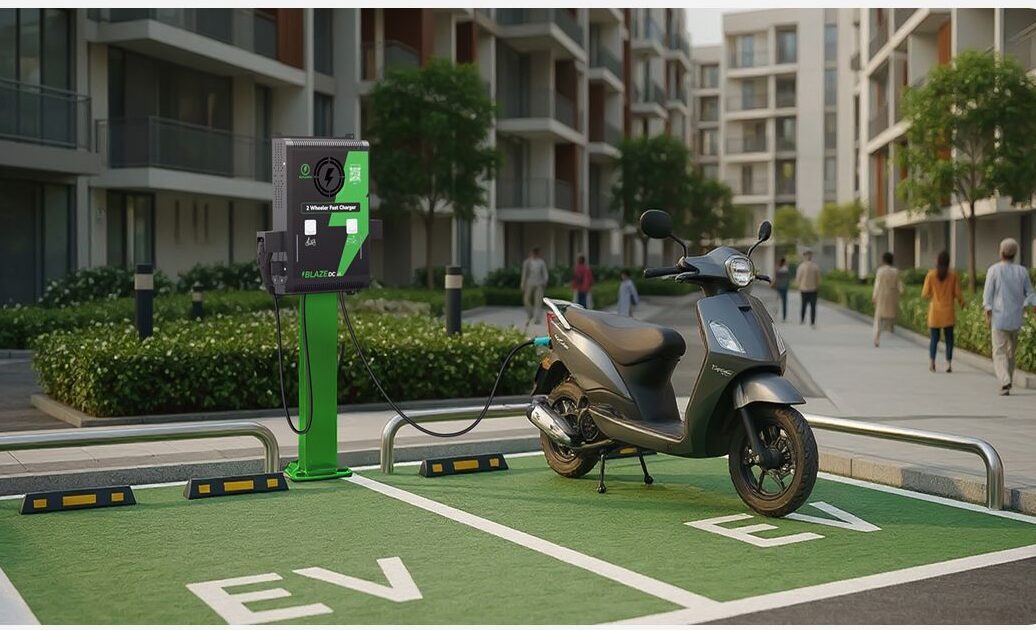
An EV charging station for residential societies works best when it's planned as community infrastructure, not as an afterthought. The most successful installations involve the RWA, residents, and the installation partner aligning early on capacity, billing, and access rules.
Key elements that decide whether the rollout succeeds:
- Load assessment—confirming whether the existing transformer can handle the additional draw, or if a separate connection is needed
- Cabling and earthing — running dedicated lines from the main panel to designated parking bays
- User authentication system — RFID cards or mobile app access so only authorised residents pay and use the chargers
- Billing transparency — per-unit metering integrated with society dues or app-based wallets
- Future scalability — leaving conduit and panel capacity for adding more chargers in 2–3 years
4. The Business Angle — EV Charging Station Dealership Setup
For entrepreneurs, an EV charging station dealership setup is one of the more grounded opportunities in the green economy. Unlike vehicle dealerships that demand massive showrooms and inventory, a charging dealership scales with demand and benefits from recurring revenue per charging session.
Rough investment ranges look like this:
| Setup Component | Approximate Cost (INR) |
|---|---|
| Site infrastructure & civil work | ₹3 – 8 lakh |
| Hardware (chargers, transformer upgrades) | ₹6 – 15 lakh |
| Software, network & app integration | ₹1 – 3 lakh |
| Licensing, approvals & DISCOM coordination | ₹50,000 – ₹1.5 lakh |
| Marketing, signage & first-year operations | ₹2 – 4 lakh |
5. The Role of a Level 3 EV Fast Charging Network
Slow chargers cover overnight residential use, but highway corridors, fleet operators, and commercial hubs need something heavier. A Level 3 EV fast charging network plugs that gap — delivering 100 kW or more, enabling cars to gain meaningful range in minutes rather than hours.
Why this matters for anyone planning serious infrastructure:
- Fleet operators (cab aggregators, delivery companies) won't park vehicles for six hours
- Long-distance travellers need confidence that they can recharge in a tea-break
- Commercial real estate using a Level 3 EV fast charging network attracts higher footfall and longer dwell time
- Cities with dense Level 3 coverage see faster EV adoption, which loops back into demand.
6. The Growing Demand for EV Charging Stations in Delhi NCR
The capital region is leading the country in adoption curves. EV charging stations in Delhi NCR have multiplied across malls, metro stations, office complexes, and residential pockets yet demand is still outpacing supply.
Delhi NCR is unique because:
- It has a high concentration of early-adopter EV owners
- The Delhi government's EV policy offers some of the most generous subsidies and registration waivers in India
- Cab aggregators are aggressively electrifying their fleets here
- Gurugram, Noida, and Ghaziabad have dense apartment clusters where charging infrastructure pays off quickly.
7. Common Mistakes to Avoid
Even good projects fail when basics are skipped. Watch out for:
- Choosing chargers based on price alone rather than warranty, service network, and software updates
- Skipping the load study and burning out transformers within months
- Ignoring billing infrastructure, leading to disputes between residents
- Picking installation partners with no after-sales presence in your city
Powering the Future with Zeway
Whether you're a society planning your first installation, a property developer building EV-ready projects, or an entrepreneur exploring an EV charging station dealership setup, the right partner makes all the difference. Zeway has built one of the most accessible and affordable charging ecosystems across Delhi NCR, working with RWAs, commercial properties, educational institutions, and dealership partners to bring practical, scalable EV infrastructure to the ground.
From AC chargers for housing societies to fast-charging hubs and complete dealership opportunities, Zeway offers end-to-end support site survey, installation, software, and ongoing service making the transition to electric mobility genuinely simple for everyone involved.