EV Charging Station Business: Franchise Cost & Maintenance
Drive through any metro on a Monday morning and the shift is impossible to miss green-plated scooters slipping between buses, silent Nexons waiting at signals, food delivery riders parked at roadside outlets instead of p
Drive through any metro on a Monday morning and the shift is impossible to miss green-plated scooters slipping between buses, silent Nexons waiting at signals, food delivery riders parked at roadside outlets instead of petrol pumps. The fuel station that powered your father's bike for thirty years is finally getting some serious competition. And the people setting up that competition entrepreneurs quietly installing chargers behind malls, schools, RWAs, and corporate parks are building one of the most interesting small-business plays in the country right now.
If you've been wondering how to start an EV charging station business, the timing genuinely works in your favour. India crossed 2 million EV registrations in 2024, and the public charging infrastructure is nowhere close to catching up with that pace. That gap between demand and supply is exactly where new operators are finding their margins. But jumping into this space without understanding the EV charging station franchise cost in India, the day-to-day maintenance load, or where demand actually lives is how most first-time operators burn through capital in the first six months. This guide breaks down the parts that actually matter costs, setup, upkeep, and the markets worth chasing.
1. Why the EV Charging Business Makes Sense Right Now
Three things have lined up at the same time, and that's rare. EV sales in India are growing at over 40% year-on-year, the government has cleared FAME-II subsidies along with state-level incentives for charging infrastructure, and corporate buyers fleet operators, e-commerce delivery companies, ride-hailing platforms are signing long-term contracts with charging providers to lock in capacity. For someone entering now, you're not betting on a future market; you're entering one that already has revenue waiting on the table.
The unit economics also work in a way that wasn't true even two years ago. A well-located AC charging station in a metro can recover its setup cost in 18 to 24 months. A DC fast charger on a highway corridor or near a commercial hub typically pays back in 24 to 30 months. These are realistic numbers, not optimistic ones assuming you've got the location right and the maintenance discipline to keep uptime above 95%.
2. How to Start an EV Charging Station Business: The Actual Steps
The process is more straightforward than people assume, but the order matters. Skip a step early and you'll pay for it later in delays or fines. Here's the practical sequence anyone exploring how to start an EV charging station business should follow before signing any cheques:
- Pick the right site first, equipment second. Footfall, EV density within a 3 km radius, parking availability, and visibility from main roads matter more than the charger brand. A premium charger in a poor location loses money. A basic AC charger in the right RWA earns steadily.
- Apply for power load sanction from your DISCOM. AC chargers typically need a 7-22 kW connection; DC fast chargers anywhere from 30 kW to 150 kW. This step takes 3-6 weeks and is the most underestimated part of the timeline.
- Register the business as a sole proprietorship, LLP, or Pvt Ltd. GST registration is mandatory once turnover crosses ₹20 lakh.
- No central license is required for public EV charging in India the Ministry of Power declassified it as a "service" but state-level NOCs from electrical inspectors and fire safety departments are still needed.
- Choose your charger hardware based on the vehicles you expect (2-wheelers, 4-wheelers, or mixed). Pair it with a CMS (Charging Management Software) that handles payments, monitoring, and OCPP compliance.
- Get discoverable. Listing on PlugShare, Statiq, and your partner's own app is what brings walk-in traffic. Without app visibility, you're invisible.
3. EV Charging Station Franchise Cost in India: The Real Numbers
The EV charging station franchise cost in India varies more than any other single factor in this business. Sales pitches will quote anywhere from ₹1.5 lakh to ₹40 lakh, and both numbers can technically be accurate they're just describing very different setups. The honest answer depends on the charger type, the location's electrical readiness, and whether you're going solo or through a franchise partner. Here's a realistic breakdown of what the money actually goes into.
| Component | AC Charger (Slow/Medium) | DC Fast Charger |
|---|---|---|
| Charger hardware (per unit) | ₹35,000 – ₹1,50,000 | ₹6,00,000 – ₹15,00,000 |
| Civil work & installation | ₹20,000 – ₹50,000 | ₹1,00,000 – ₹2,50,000 |
| Electrical setup & transformer | ₹15,000 – ₹40,000 | ₹2,00,000 – ₹5,00,000 |
| Software/CMS (annual) | ₹10,000 – ₹25,000 | ₹40,000 – ₹80,000 |
| Licensing, NOCs, and signage | ₹15,000 – ₹30,000 | ₹50,000 – ₹1,00,000 |
| Total (approximate) | ₹1.5 – 3 lakh | ₹12 – 25 lakh |
What Pushes the Cost Up or Down
Land lease is often the silent killer a charger in a Connaught Place location pays 5x the lease of one in a Tier-2 town for the same hardware. Franchise tie-ups also vary; some partners charge a one-time fee and let you keep most of the revenue, others take a recurring percentage in exchange for software, support, and customer acquisition. The right model depends on how hands-on you want to be.
4. Types of Chargers and What Each One is For
Different vehicles need different chargers, and matching the wrong one to your location is the most common early mistake operators make. A high-end CCS2 fast charger installed near a society full of e-scooters is wasted capital. A 3.3 kW AC point at a highway dhaba won't survive its first weekend. The table below maps the realistic options in the Indian market right now.
| Charger Type | Power Output | Best For | Charge Time (Full) |
|---|---|---|---|
| Bharat AC-001 | 3.3 kW | E-scooters, e-rickshaws, RWAs | 6 – 8 hours |
| Type 2 AC | 7.4 – 22 kW | Cars at offices, malls, homes | 3 – 6 hours |
| Bharat DC-001 | 15 kW | Mid-range EVs, fleet hubs | 1 – 1.5 hours |
| CCS2 DC Fast | 50 – 150 kW | Highway corridors, premium EVs | 30 – 60 minutes |
| CHAdeMO | 50 kW | Older Nissan/Tata EVs (declining) | 40 – 60 minutes |
5. EV Charging Station Maintenance: The Operating Cost Nobody Discusses
This is the part most franchise sales decks skip and it's the part that decides whether your station is profitable in year two. EV Charging Station Maintenance covers everything from cleaning connectors and cable inspections to firmware updates, transformer health checks, and software uptime monitoring. Skip any of it for a few months and you'll start seeing failed charging sessions, customer complaints, refund requests, and the kind of one-star app reviews that quietly bleed your traffic away.
A typical AC charger needs light monthly attention and a quarterly deep check. DC chargers are more demanding liquid cooling systems, higher-voltage components, and sensitive power electronics that need professional servicing every 2-3 months. Routine EV Charging Station Maintenance generally costs 4-8% of annual revenue, which is a number worth budgeting from day one rather than treating as an unexpected expense later.
Key maintenance tasks to schedule:
- Connector and cable inspection for wear, burn marks, or moisture damage
- Firmware updates for OCPP compliance and security patches
- Transformer load testing and earthing checks (critical during monsoon)
- Backend software audit payment gateway, session logs, billing reconciliation
- Physical cleaning of the charging point, lighting, and signage
Common Issues You'll See in the First Year
Connector wear from rough handling, payment gateway timeouts during peak hours, RFID card sync errors, and software bugs after firmware updates are the four issues that show up at almost every site. None of them are dealbreakers individually, but stack them up over a few months without attention and you'll lose customer trust faster than you can earn it back.
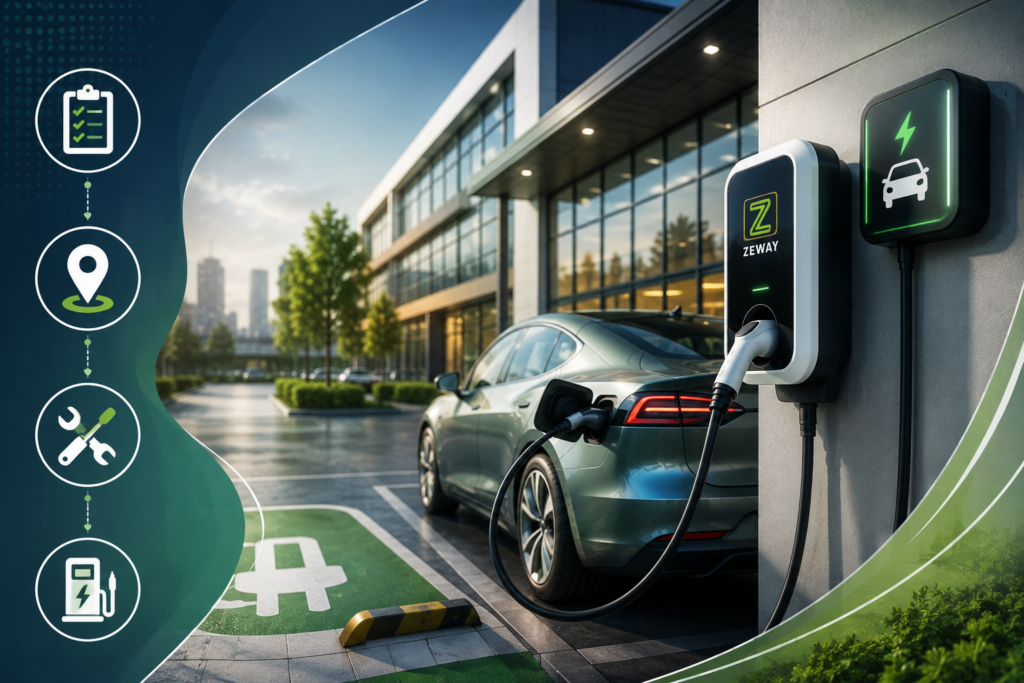
6. EV Charging Stations in Delhi NCR: Why This Market Leads
If you're asking where to start, the answer for most operators is Delhi NCR. The region has the highest EV penetration in North India, a state government actively incentivising charging infrastructure, and a dense network of RWAs, corporate parks, and commercial hubs that are actively asking for installations rather than waiting to be sold to. EV charging stations in Delhi NCR have grown from a few hundred points in 2022 to over 5,000 operational chargers in 2026 and demand is still outpacing supply, especially in the residential apartment and corporate office segments where utilisation is highest.
Micro-markets worth targeting specifically:
- Gurugram (Cyber City, Golf Course Road, Sector 49-57 residential belts)
- Noida and Greater Noida West (high EV ownership in newer societies)
- Ghaziabad (Crossings Republik, Raj Nagar Extension — strong RWA adoption)
- Faridabad (Sectors 21-29, catching up fast)
7. Mistakes That Sink First-Time Operators
- Overspending on hardware before validating the location with real foot-traffic data
- Choosing a charger that doesn't match the dominant EV type in the area
- Underestimating the time required for DISCOM load sanction
- Skipping signage and app listings invisible chargers don't earn
- Treating maintenance as optional rather than budgeting it from day one
Read This Blog Also- EV Charger Installation for Societies & Dealership Setup
Partner With Someone Who's Already Done the Hard Part
Setting up alone means making every mistake yourself, and learning each lesson the expensive way. A working alternative is to partner with an operator who already has the site network, the hardware relationships, the DISCOM playbook, and the maintenance teams in place.
Zeway has been building affordable EV charging stations across Delhi NCR for several years working with RWAs, schools, commercial properties, and public spaces on a profit-sharing model that lets you enter the market without locking up large capital upfront. From site assessment and installation to ongoing software support and EV Charging Station, the heavy lifting is already handled.
If you want to start an EV charging station business in Delhi NCR or expand into Lucknow and Kanpur where Zeway is already operating, visit Zeway to explore partnership options that fit your capital and risk appetite.