How to Install EV Charging Station in Commercial Building Easily
The surge of electric vehicles is changing how businesses use their commercial spaces. To draw customers and employees and hedge their property investments, businesses, malls, office complexes, hotels, residential areas,
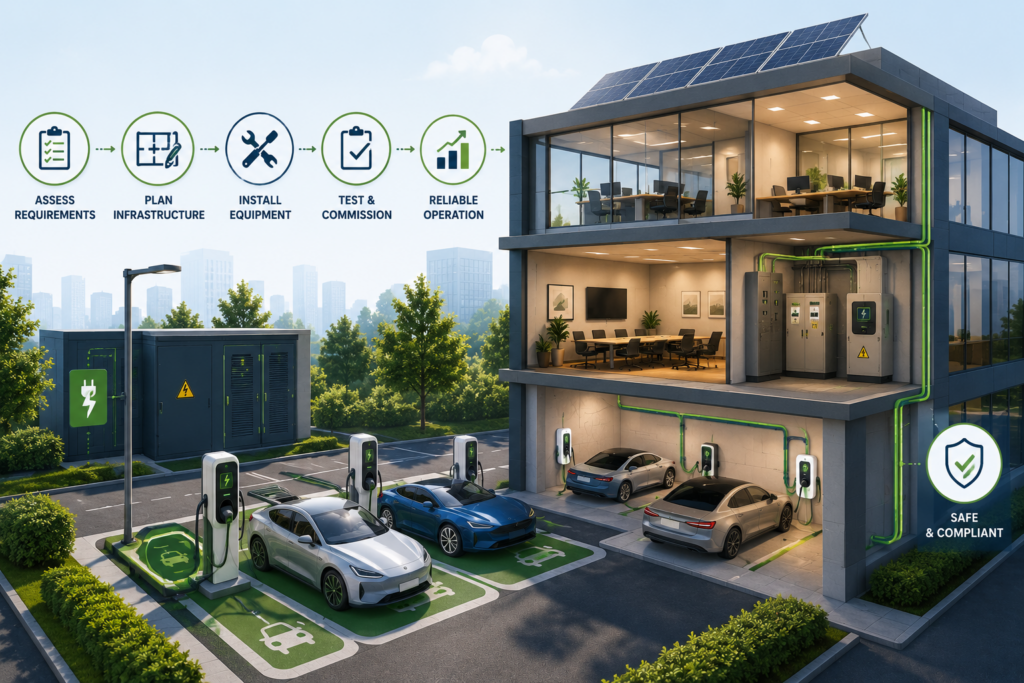
The surge of electric vehicles is changing how businesses use their commercial spaces. To draw customers and employees and hedge their property investments, businesses, malls, office complexes, hotels, residential areas, and retail centers are building EV infrastructure. Property owners can learn the Install EV Charging Station in commercial buildings to optimize their investments and give convenience in charging.
Whether you are thinking of building an Electric 2-wheeler charging station, if you’re deciding between an AC and DC EV charger station, and if you’re searching for EV charging stations in Delhi NCR, efficient plans for installation are a must. This guide outlines necessary steps and the most efficient installation practices.
Estimate Charging Demand on Your Property
The first step in the building process is to evaluate what the demand for charging the vehicles will be. Due to the varying customer base, each type of commercial property will rely on a different type of charger and require different charging infrastructure.
Some questions to help guide this evaluation include:
- How many vehicles come each day?
- How will the charging station fit in the allotted parking spaces?
- How long will each vehicle stay parked and available to charge?
- How many people will adopt EVs in the future?
- How much electrical current is available to use?
Install EV Charging Station in Commercial Building projects is to get a professional survey done before equipment purchase to avoid expensive relocation of charging stations and to better placement.
AC vs DC Charging
The type of charging infrastructure built provides a differentiating factor for your customers and will have a large impact on your costs. Understanding the difference of EV charger stations will help your business.
AC EV Chargers
AC chargers are great at spots where cars are going to sit for a long time.
- Some advantages are:
- Lower costs to install
- Less power is needed
- Perfect for office buildings and residential complexes
- Great for charging overnight
DC Fast Chargers
DC chargers are best for people who need a quick charge and are not staying for long.
Some advantages are:
- Faster speeds
- Best for chargers at commercial hubs and highways
- Better convenience for customers
- More likely to be used
Plan Electrical Infrastructure Improvements
Installing EV charging in commercial buildings typically requires an upgrade to the building’s electrical systems. An on-site assessment by qualified professionals helps to identify the existing power capacity and the limitations of the current infrastructure.
Build the following into the assessment:
- Capacity of the building’s transformers
- Load distribution needs
- Dedicated electrical distribution panels
- Safety standards
- Potential for future building expansion
Add Electric 2-Wheeler Charging
Electric scooters and bikes are gaining popularity in urban environments. Commercial buildings with charging for 2-wheelers gain a competitive advantage.
The benefits of electric 2-wheeler charging stations are:
- Reduced costs for installation
- Small footprint
- Attractive property
- Aid for sustainable transit
- Increased customers for retail
Installing an Electric 2-wheeler charging station greatly benefits your company’s EV Infrastructure.
Choose the Correct Partner for Installation
Having a quality installation company is the most important aspect for the success of the EV charging project. Site assessment, proper equipment choice, installation, implementation, and upkeep are all easily supported by quality installation companies.
Look for providers that meet the following criteria.
Companies should offer:
- Complete project management
- Trained and certified installation teams
- Smart charging technology
- Service for maintenance
- Charging networks that scale with need
Use Smart Charging Management Systems
Sophisticated software in modern EV charging stations improves both the control of operations and the user experience.
Examples of smart charging are:
- Remote access
- Monitoring real time
- Controlling energy
- Mobile applications
- Automation of billing and payments
Give Charging Stations Strategic Locations
The right stations can make or break an EV station. Charging stations should be properly placed where users can see them. Also, charging stations should be placed in areas with easy access to parking.
Some good places are:
- Main parking lot entrances
- Staff parking lots
- Customer parking lots
- Along retail shopping avenues
- Hospitality sites
- Proper locations help users the most and maximize utilization.
- Make Safety a Priority
Safety must be the focus for all charging station installations. Property owners have to consider and comply with the various electrical and fire safety codes as well as the charging station safety standards.
Some safety measures that need to be considered are:
- Grounding systems
- Weatherproofing
- Automatic shutoffs
- Electrical safety
- Routine maintenance
Reasons to Consider EV Charging Stations in Commercial Buildings
The initial investment to build EV charging stations is significant. However, beyond sustainability, the investments pay for themselves in other ways.
Some of these are:
- Value added for customers
- Higher Property Value
- New revenue sources
- Better business image
- Support for green mobility
- A clear edge over competitors
Final Words
Installing EV charging stations in commercial buildings offers straightforward solutions. To develop a future-ready, responsive charging ecosystem, businesses need to assess the property, select appropriate charging technologies, upgrade their infrastructure, and partner with skilled professionals. The steps described in to Install EV Charging Station in Commercial Building, Electric 2-wheeler charging station and EV charging stations in Delhi NCR will provide commercial property owners the tools to develop a successful solution that addresses the growing needs for electric mobility services.
Zeway offers commercial businesses flexible, charging solutions that are reliable and easy to scale. Zeway’s charging solutions include advanced charging infrastructure, smart energy management systems, and Zeway’s expertise for AC and DC charging solutions. It empowers organizations to build responsive, future-ready, and sustainable mobility solutions.